Make the hardest week a little easier for your family.
Write down what you want to happen when you die, and leave something for the people you love. It stays private while you're alive. When the time comes it goes to the right people, and not before.
Works in any browser.
Or get the app for iPhone or Android.
The worst week is spent guessing
Burial or cremation. Which songs. Where the will is kept. Whether there's a plot already paid for. A family has a week to answer all of it, at the worst moment of their lives, and most of the answers were never written down.
Write it down once
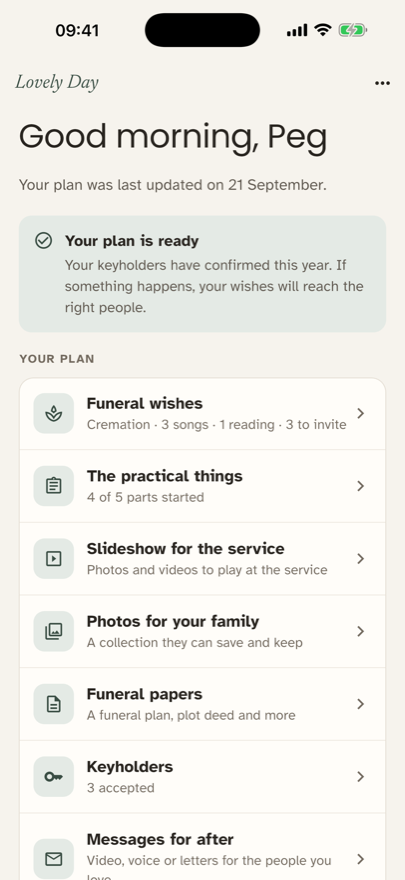
Your funeral wishes
Burial or cremation, the songs, the readings, who speaks, who carries you, who you'd rather wasn't invited. Change any of it whenever you like.
The actual songs
Search for the music you want played and hear thirty seconds of it before you decide, or paste a link from Apple Music, Spotify or YouTube. Your family gets the song you meant, not a half-remembered title.
The practical things
Where the will is, which bank, whether there's a prepaid funeral, who looks after the dog. Where things are kept and who to ask — never passwords or account numbers.
Nobody sees it while you're here
Not your family, not your keyholders, not us.
What it looks like
Choose who can tell us
Your keyholders are the people who'll know quickly: family, close friends. When you die, two of them have to agree before anything is shared, and we email you first in case it's a mistake.
Only then do they get your wishes, your funeral papers and the photo you chose for the order of service. A keyholder can pass a funeral director their own link, showing what's needed to arrange the funeral and nothing else.
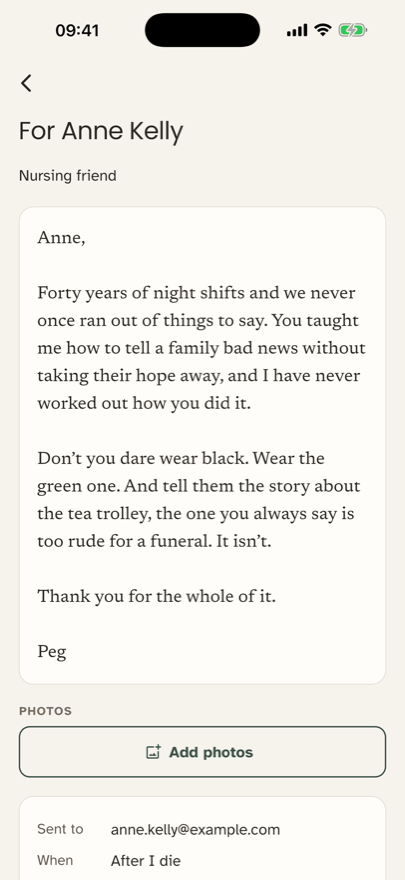
Messages they get after you die
Record a video, leave your voice, or write a letter for one person. Each one goes only to the person it's for, once your death has been officially registered and we've seen the paperwork. You can date one for a birthday or a wedding years away.
Nobody else ever sees them. Not your keyholders, not your family.
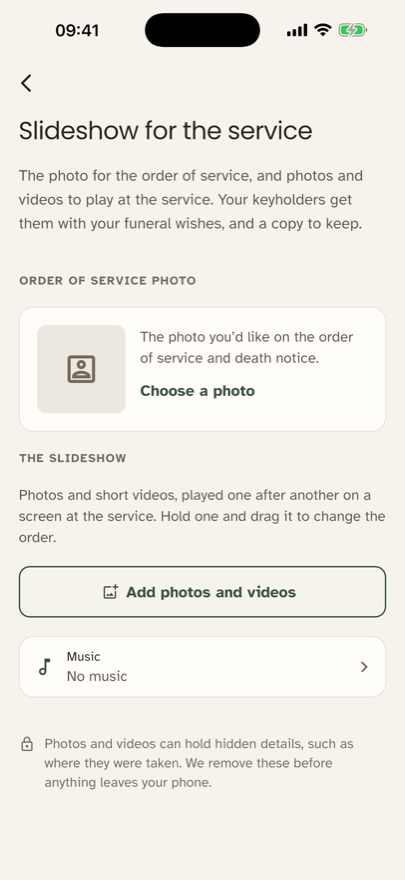
A slideshow, and photos to keep
Choose the photos and videos to play at the service, in the order you want, with the music you want. Keep a separate set for the family to have afterwards.
On the day, your keyholders have a link they can open on any screen — and pass to the funeral director.
What it costs
Free
Your wishes, written down
- Funeral wishes and the practical things
- Your keyholders, and your wishes shared after you die
- 5 photos
-
A slideshow for the service
The photos you’ve chosen, with your music, on a web page that fills the screen. After your death your keyholders get the link, and they can pass it to the funeral director — so it can be played on the screen at the service without anyone installing anything. See an example.
A$57.99, once
Everything else, for good
-
Messages they get after you die: video, voice and letters
Record a video or a voice message, or write a letter, for one person. It’s sent after your death has been registered and checked — or on a date you choose, even years away. Only the person it’s for ever sees it, not your keyholders and not us.
-
100 photos
Twenty times what the free plan keeps. They go into the copy your family keeps, and you choose which of them the service sees and which one is the photo for the order of service.
-
Videos in the slideshow
Everyone gets a slideshow of photographs. The paid plan lets you put video in it as well — a few seconds of someone moving and speaking, among the pictures, on the screen at the service.
-
60 minutes of video
For your messages and for the slideshow. The free plan has no video at all.
-
300 minutes of audio
Five hours of voice messages — for the things you’d rather say than write. The free plan has none.
-
200 MB of funeral papers
Scans or photos of the papers your family will need, kept with your wishes so nobody has to hunt for them. After your death your keyholders see them, and so does the funeral director they give a link to.
No subscription, and nothing more to pay, ever. The price above is the price where you are, and it's what you pay — in most countries the tax is already in it, and where it has to be added instead you'll see that before you pay. Buying in the iPhone or Android app costs the same and gets you the same plan. We keep everything for as long as you have your account, and for at least five years after your death.
Why it's one payment
Almost everything in this corner of the internet is rented. A yearly fee to keep your documents somewhere, another to carry on editing them, sometimes a charge to get back in if you ever stop paying. That's a fair way to sell something you use this year.
It's an odd way to sell something whose only job is to still work in forty years — when the card on file has expired, the email address is dead, and you're not around to notice either.
So Lovely Day is one payment. Nothing renews, nothing lapses, and nothing of yours has to keep working for this to keep working.
What we're not
Lovely Day isn't trying to be the cleverest thing on the internet. There's no feed, no streak, nothing that pesters you to come back — the app sends no push notifications at all. This page is plain HTML with a single small script on it, and what's underneath is built the same way.
That's deliberate. Something simple is cheap to run, and something cheap to run is something we can keep running on one payment, without coming back to you for more. There's no advertising inside Lovely Day, no analytics, and nothing about you is sold — not now, not later. If an advert brought you here, we tell that platform somebody who clicked it signed up, and nothing else about you; the privacy policy says exactly what that is.
It's made by Stuart Kidd, who has been building on the internet since 1996 — thirty years of watching services get bought, pivoted and switched off. Lovely Day is built to be handed on: to the people who work on it, and to his family.
We won't promise to be here forever, because nobody honestly can. What we will promise is written in the terms: ninety days' notice if we ever stop, your copy of everything available the whole time, and anything already in hand for a death we've confirmed finished properly. The arrangements for handing Lovely Day on aren't finished yet, and we say so there too.
Being straight with you
- It isn't a will
- Your wishes guide your family and your funeral director. Anything that must be legally binding belongs in a will.
- Where it's kept
- Everything is kept in Australia, encrypted.
- If something goes wrong
- The database can be put back to any second in the last fourteen days, and a file that's deleted or overwritten can be recovered for thirty. We've rehearsed doing it rather than assuming it would work.
- You can take it, or leave
- Ask for a copy whenever you like and we'll email you a link to one file with everything in it, your messages included, that opens without Lovely Day or the internet. The link works for seven days. Nothing here is locked in, and you can delete your account from inside the app, any time.
Start with one thing
Most people begin with the songs, or with who looks after the dog. A few lines today is already more than most people leave behind, and you can change any of it whenever you like.
Also on the App Store and Google Play.