The Decisions Get Made the Next Morning
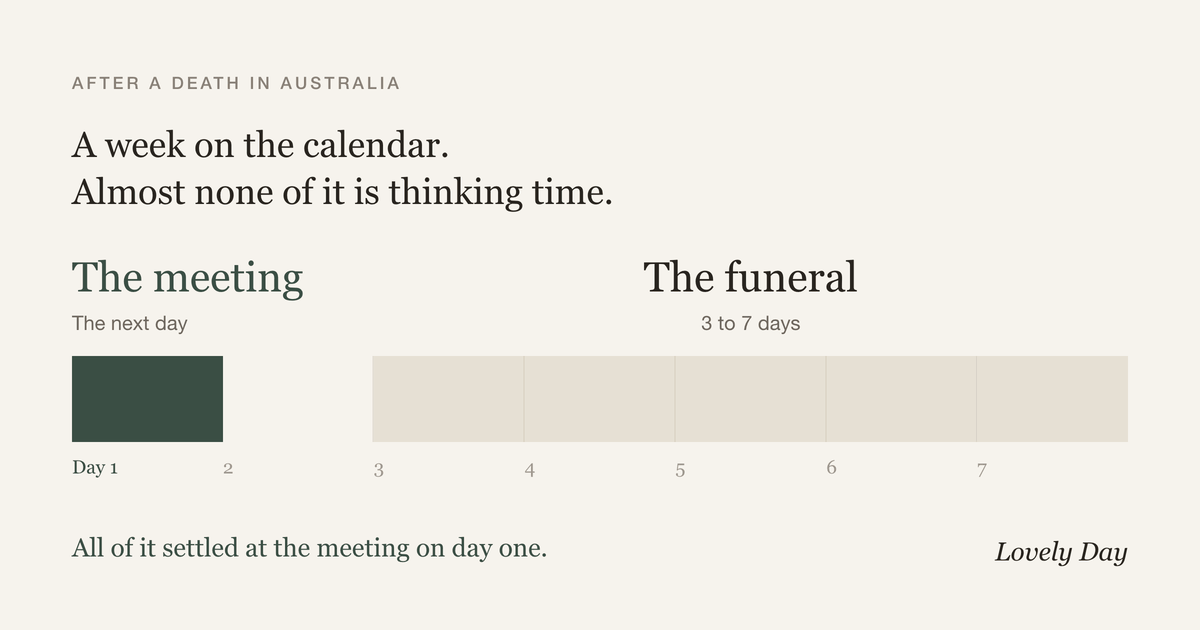
If you have never arranged a funeral, the timeline is shorter than you probably picture. Not the funeral itself. The decisions.
Greenfields, a Perth funeral director, lays the sequence out on its own website. After a death in hospital they say they "typically arrive at the hospital within 2-4 hours" of being called. Then this: "The next day (or whenever you're ready), we'll meet with you to discuss arrangements."
The funeral is still a week away. Perth Cremations puts it at "within 3 to 7 days after a death" in Australia. So there is a week on the calendar, and almost none of it is thinking time, because the meeting that settles the week happens at the start of it.
What gets decided at that meeting
Perth Cremations describes what the funeral director helps coordinate: "the date, time and location, along with details such as the celebrant or clergy, coffin, flowers, music, notices and service style." Before any of that, the family has to decide "what type of farewell feels most appropriate," which may include "a funeral service, cremation or burial service."
Western Australia's Consumer Protection puts a shorter version in its guide for consumers organising a funeral. It lists the minimum legal requirements: choosing between a burial or cremation service, purchasing either a coffin, casket or shroud, choosing transportation of the deceased body, and choosing mortuary care.
Read those two lists together and you have most of what people mean when they talk about someone's funeral wishes. Burial or cremation. Where. When. Who runs it. What is played. Who gets told. All of it, in one sitting, on the first morning.
Some of it can be revised afterwards. In practice much of it cannot, because the date goes in first and the venue, the celebrant and the notices all hang off the date. Once those are booked, changing your mind means unpicking other people's calendars during the week you least want to be making phone calls.
The official advice does not fit the timeline
Here is the part that surprised us. The same Consumer Protection checklist gives sensible, specific advice, and the advice assumes more time than the family has.
It says: "Seek quotes from at least three funeral companies. Funeral directors are legally required to provide you with an itemised price list within two business days of request."
Two business days is a reasonable rule and a real protection. It is also longer than the gap between the death and the meeting. If someone dies on a Friday evening, the arrangement meeting is Saturday or Sunday, and the itemised price lists you were told to compare can legally arrive on Tuesday. Even requested in parallel, done exactly as advised, the paperwork can turn up after the morning you were using it for.
The checklist also says, under its own note to the reader, "Do not let the funeral directors rush you into making a decision." That is good advice and worth keeping. It is worth being fair about where the pressure actually comes from, though. In our reading it is mostly not the funeral directors, who are generally the people in the room trying to slow things down and explain the options. It is the calendar. A body needs care, a venue needs booking, relatives are already looking at flights, and somebody at the table has to say what the person would have wanted.
The checklist's first instinct is to look for a document
One line in that checklist is easy to skim past: "Check the deceased person's will for any funeral preferences."
That is the official answer to how a family is supposed to know. Go and read the will. It is a good answer when the will says something, and a will is a sensible place to put it. It is worth knowing what that entry does and does not do, though. Legal Aid WA's guidance is that "normally, the executor of the deceased's will (or personal representative if there is no will) has the right to decide on the funeral arrangements as they think best." What you wrote informs that decision. Mostly it does not override it.
There is one sharp exception in Western Australia, and it is worth knowing because it rewards writing things down rather than saying them. A person cannot be cremated if they left written instructions, including in a will, that their body is not to be cremated. That is a rule about a document, not about a conversation. Where no written instruction exists, cremation can still be blocked if the spouse, de facto partner or senior next of kin opposes it. Rules like this differ between states and between countries, so check the ones where you live. The shape of them tends to be the same: written instructions carry weight that remembered ones do not.
Most wills say nothing about any of this, because a will is built to move property to people. So the question falls back to memory, and to whoever in the family sounds most certain at the time.
To be clear, because the two get confused: a written set of funeral wishes is not a will and does not replace one. A will deals with your estate and needs to be done properly, with proper advice. The wishes are a separate, smaller document that answers a different question, the one nobody can look up on the first morning.
It is not the same everywhere
The next-morning pattern is not universal, and it would be wrong to present it as a global rule.
In the United States, an industry guide from Earth Funeral says "most families contact a funeral home within a few hours", and puts the average time between death and burial at "2 to 4 days for straightforward cases." The same page notes the range has widened, and that "many funerals now take place 10 to 21 days after death due to paperwork delays, crematorium schedules, and family logistics." In the United Kingdom, Dignity says a funeral is "typically held around one or two weeks after the death."
So the funeral can be three weeks out. The first conversation is still in the first day or two. A longer wait for the service does not hand the decisions back, it just means the family lives with them for longer.
The part you can do now
None of this is an argument for doing anything dramatic. It is an argument about timing. The decisions that make up a funeral get made in a single meeting, early, by people who are tired and guessing, working from a document that was not written to answer the question.
The window where you can affect any of it is now, while it costs you an hour and no distress at all. Write down the few things you actually have a view on. Burial or cremation. Whether you want a service. Where. One or two songs, if you care about the songs. Who should be told. Then tell the people who will be in that room where to find it.
That is the whole task. It is smaller than people expect, and it is the difference between a family deciding what you would have wanted and a family reading what you wanted.